Showing posts with label Shostakovich Dmitri. Show all posts

Sunday, November 29, 2015

SHOSTAKOVICH The Cello Concertos


“Gautier Capucon is too consummate a musician to opt for pale imitations. Working hand in glove with Valery Gergiev and the Mariinsky Orchestra, he delivers passionate and rhythmically incisive accounts…[there is] much to admire here, particularly in the way both soloist and orchestra ratchet up the emotional temperature throughout the course of the second movement [of the Second Concerto]” --BBC Music Magazine, December 2015


Gautier Capucon (cello) - Mariinsky Theatre Orchestra, Valery Gergiev

“Capuçon and Gergiev deliver some grand and glorious moments” wrote Gramophone when the French cellist Gautier Capuçon and the Russian conductor Valery Gergiev last collaborated on a disc of Russian music for Erato – works by Prokofiev and Tchaikovsky, released in 2010. The Daily Telegraph found that: “Capuçon [plays] with a blend of impeccable taste, Romantic ardour and technical aplomb ... Whether quizzical, rapturous, pensive or demonstrative, Capuçon has full measure of [the music] here in a performance of impressive stature.”

Now, the two musicians -- whose collaboration, again in Gramophone’s words, “was bound to strike sparks” – have come together for two live recordings, made in December 2013 at Paris’s Salle Pleyel and June 2014 at St. Petersbourg’s Mariinsky Thetre with the Mariinsky Orchestra. The works in question are Dmitri Shostakovich’s cello concertos Nos 1 and 2, both of which were written for Mstislav Rostropovich. The first was composed in 1959 (a year after the Central Committee of the Communist Party admitted that in 1948 there had been unjust condemnation of Shostakovich and other composers as ‘Formalist’), the second in 1966. The two concertos are different in spirit and shape: the first is often assertive and energetic, and features a huge cadenza for the cello that is almost a movement in its own right, while the second is introspective and enigmatic.

When Capuçon played the Concerto No.1 in New York in early 2014, the New York Times said: “Mr Capuçon played the work beautifully, negotiating its difficulties with seeming ease ... his elegance paid dividends ..., especially in the meditative Moderato and the brooding opening of the cadenza.” When he took the piece to Montreal, also in early 2014, the news website Pieuvre.ca reported that “[his] sensitive, virtuosic interpretation was rewarded with a long ovation.”

“Gautier Capucon immediately shows that his are interpretations to be reckoned with. His account of the first movement of the First Concerto brings to bear an exceptional variety of articulation where lesser players storm through regardless.” --Gramophone Magazine, November 2015

Saturday, November 28, 2015

SCHUBERT, BRITTEN & SHOSTAKOVICH Mysteries for Viola


Rachel Roberts is one of Europe’s leading violists and performs internationally as soloist and chamber musician.

Prizes for her chamber music recordings include the Diapason D’or, the ‘Supersonic Award’ of Pizzicato magazine, Luxembourg, CD of the month in Fonoforum Magazine, Germany, and BBC Chamber Choice in Gramophone Magazine. Rachel Roberts has recorded chamber music for labels Hyperion, Champs Hill Artists, Signum Classics, cAVI in Germany and Deutsche Rundfunk.
Release date: November 27, 2015

Thursday, November 26, 2015

SHOSTAKOVICH Symphony No. 7 in C major, Op. 60 'Leningrad'


“Paavo Järvi's Leningrad is the opposite of his father's 1988 epic with the Scottish National Orchestra - light, laconic and sonically lean where Neeme's recording was spectacularly big in every way.” --BBC Music Magazine, August 2015

“Järvi and his engineers offer ruthless clarity and precision, exposing a rogue E flat clarinet with a flash of the theme at one point (never heard that before) and lacerating flutter-tongued trumpets as the shock and awe peaks…there is no denying the excellence of the playing.” --Gramophone Magazine, May 2015


Russian National Orchestra, Paavo Järvi

It is hard to escape the incredible pull of Symphony No. 7, knowing the background to its composition and its general significance. Shostakovich began to work on the actual composition in July 1941 in Leningrad, where he wrote the first three movements under constant attack from the enemy; and after his evacuation from the city besieged by German troops, he completed the Finale and the instrumentation in Kuibyschev in December 1941.

This outstanding work achieves its true dimensions thanks to the sophisticated and polished conductor Paavo Järvi conducting the Russian National Orchestra in this recording. Needless to say he elevates the composition to an even higher level.

The round and open sound of PENTATONE’s multichannel recording on SACD assures an honest yet captivating listening experience.

“Even before the war, hardly a family could be found in Leningrad that had not suffered a loss: the father, the son; and if not a family member, then a close friend. Everyone had someone to mourn. But you had to cry softly, under your blanket. You could not let anyone see you: everyone was afraid of everyone else. We were crushed, suffocated by grief. It choked us all, including me. I had to turn it into music, I felt it was my duty and obligation. I had to write a requiem for all those who had died, for all those who had been tortured.” (Extract from Shostakovich’s posthumously published memoirs: The Memoirs of Dmitri Shostakovich).

Thursday, November 19, 2015

De Profundis


'De Profundis' - its title taken from a 1998 piece by the young Lithuanian composer Raminta Serksnyte featured on the album - is designed to be, as Kremer puts it in his notes, 'fuel for the soul,' drawing from a deep artistic and emotional well. The composers, whose works span nearly two centuries, are: Jean Sibelius, Arvo Part, Raminta Serksnyte (whose piece, 'De Profundis,' lends the album its title), Robert Schumann, Michael Nyman, Franz Schubert, Stevan Kovacs Tickmayer, Dmitri Shostakovich, Lera Auerbach, Astor Piazzolla, Georgs Pelecis, and Alfred Schnittke.


Kremer writes of them, 'Out of the depths' these artists cry out for a better world... Their spiritual missive, like oil, can sustain humans by appealing to their profoundest emotions, by letting them open up, 12 pieces selected for this album sends its own individual message to the listener, one that my colleagues from Kremerata Baltica and I have tried to illuminate.'

The album also features the youthful Kremerata Baltica, the chamber ensemble of fellow Latvian musicians he founded. Kremer's 2009 Nonesuch release with Kremerata Baltica was the acclaimed two-disc 'Mozart: The Complete Violin Concertos,' which BBC Music Magazine, in a five-star review, called 'an altogether impressive achievement.' The New York Times concurred: 'Gidon Kremer's great interpretative strength has always been his ability to make a work, however familiar, entirely his own.'

Kremer and Kremerata Baltica will perform selections from 'De Profundis' on their 2010-11 tour, which will include visits to most major American markets. Regarding the ensemble's interpretative powers, the Los Angeles Times has declared, 'They are utterly alive to the possibilities in the scores. They make every detail stand out; they play with an overpowering sense of joy... and they are deep.'

Tuesday, November 3, 2015

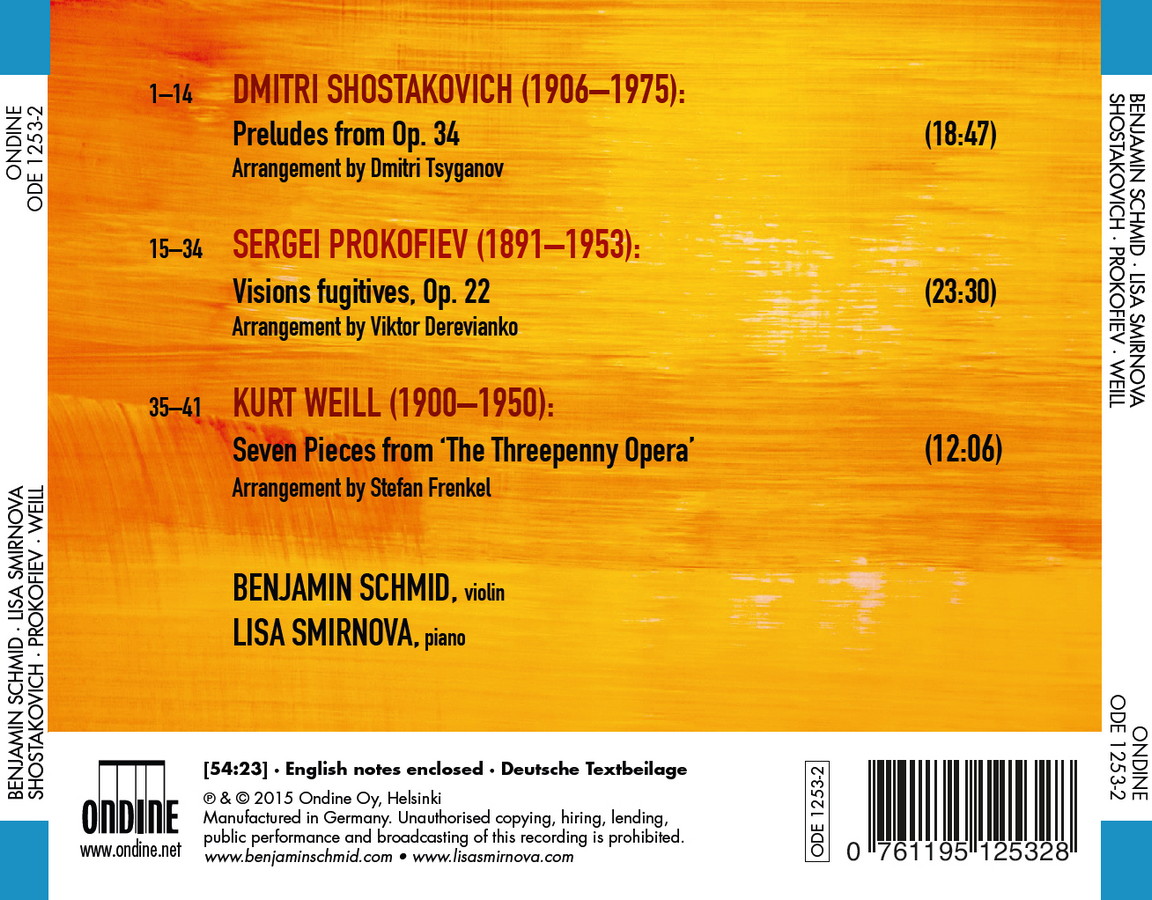
SHOSTAKOVICH, PROKOFIEV & WEILL Music for Violin and Piano

This release contains fresh arrangements of well-known piano pieces by Shostakovich and Prokofiev for violin and piano. Also included is a suite transcribed from Kurt Weill's iconic ‘The Threepenny Opera'. All the three original works by the composers were written during the 1910s and 1920s.

“I imagine not every listener will respond positively to this thoroughly unorthodox recital, in which nothing is quite as its composer intended. What cannot be denied is the passionate engagement of the soloist, a big-toned player…[and] an accomplished jazz musician…this long-gestated project has a dangerous exuberance all its own.” Gramophone Magazine, May 2015


Third release on Ondine by the Austrian star violinist Benjamin Schmid contains fresh arrangements of well-known piano pieces by Shostakovich and Prokofiev for violin and piano. Also included is a suite transcribed from Kurt Weill's iconic ‘The Threepenny Opera'. All the three original works by the composers were written during the 1910s and 1920s.

Known for his exceptionally wide repertoire and a great sense of musicality Benjamin Schmid is one of the most versatile violinists of today. Described as "one of the most valuable of today's golden-age-violinists" (The New York Sun), Schmid has performed with orchestras such as Wiener Philharmoniker, Philharmonia Orchestra, Royal Concertgebouw, Gewandhausorchester Leipzig, Tonhalle-Orchester Zürich, National Symphony Orchestra Washington, Gulbenkian Orchestra, and Chamber Orchestra of Europe. He is also a sought-after jazz violinist. In 2006 the Strad Magazine wrote: "Schmid mesmerises from his very first entry, shaping phrases with a skin-rippling sensitivity to send the spirits soaring. His golden tone, immaculate intonation, faultless technique and total identification with this magical score are truly things of wonder."

Benjamin Schmid is joined in this recording by pianist Lisa Smirnova with whom Schmid has been collaborating in an extensive way for almost 20 years.

Shostakovich wrote to Tsyganov regarding his transcriptions of the piano Preludes Op. 34: "When listening to this transcription I forgot that I wrote these preludes for the piano as they now suit the violin so well."


Thursday, October 29, 2015

SHOSTAKOVICH's Circle

"All told, a highly recommended disc, for its unfamiliar repertoire and the high quality of the performances." --FANFARE

"All three works on this recording were written in 1946, one of the darkest years for Russian culture. There was a real pogrom in Soviet literature that year, which only served as a dress rehearsal for the pogrom of Soviet music two years later, when Shostakovich, Prokofiev, Miaskovsky, Khachaturian and many other Soviet composers of the highest rank were officially and publically reprimanded for writing 'formalist' music." --Yuli Turovsky


Titled Shostakovich’s Circle , this fascinating program is tied together by a pair of conceptual threads: All three works were composed in 1946, and both German (or Herman) Galynin (sometimes Galinin) and Galina Ustvolskaya were students of the maestro’s at the Leningrad Conservatory. Galynin is by far the lesser known. He studied with Shostakovich from 1943 to 1948, while he was in his early-20s, and later received a Stalin Prize for his Epic Poem on Folk Themes , but apparently had mental difficulties throughout his life and died in 1966 from causes related to his schizophrenia. Though his catalog of works is small, Melodiya did record several pieces during the 78-rpm and LP eras, including his piano trio, two string quartets, and at least three versions of this concerto, none of which are currently available. Barry Brenesal reviewed a recent release of solo piano pieces in Fanfare 32:2, citing his “imaginative” use of less-than original materials. There’s nothing particularly original about the concerto, either, but despite the fact that it was a student work it is well made and exhibits passages of serious expression in the slow middle movement. The shift to a dark and introspective mood after a bold and boisterous first movement no doubt reflects the influence of his teacher, and there are some familiar Shostakovich touches in the orchestration, such as the prominent xylophone and the piano’s suggestion of tolling church bells. The lighter mood returns in the scampering finale; Shostakovich called this movement “somewhat superficial,” but it might have been composed earlier, when Galynin was studying with Miaskovsky.

Even more impressive, however, is the Piano Concerto of Galina Ustvolskaya. A pupil of Shostakovich’s from 1937 to 1941, she quickly developed a modernist slant that some scholars and critics feel may have in turn influenced her teacher—and, in fact, it is said that Shostakovich proposed marriage to her following the death of his first wife. Her starkly textured, succinctly organized, spiritually intense later work finally received some deserved attention in the 1990s, but the Piano Concerto, her earliest work extant, reveals a debt to not only Shostakovich, but Prokofiev and Bartók as well. A single movement essaying several distinct episodes, it pits the brittle, often bitter piano against an orchestra that is seldom comforting or supportive; even in calmer moments the mood is of anguish rather than respite, and melodies frequently lock into a paralysis of repeated motifs. Serhiy Salov does a remarkable job in this concerto—he attacks the toccata-like passages with fervor, and the grit in his tone suits the temperament of the music. He takes more risks than does pianist Oleg Malov in his performance (Megadisc), including the insinuation of an underlying hint of despair that makes the final C-Major chord seem all that more empty and ironic. The filigree of the Galynin concerto holds no difficulty for him, but the Ustvolskaya makes more interpretive demands, and Salov is up to the task.

Completing the program is Rudolf Barshai’s 1990 transcription of Shostakovich’s Third String Quartet for strings, winds, and harp. My preference is for the lean textures and wry demeanor of the original instrumentation, but conductor Yuli Turovsky, himself a graduate of Moscow’s Tchaikovsky Conservatory, emphasizes its chamber-music origins and avoids the trap of attempting to turn the music into a full-blown symphony. All told, a highly recommended disc, for its unfamiliar repertoire and the high quality of the performances.

FANFARE: Art Lange