Showing posts with label Prokofiev Sergei. Show all posts

Tuesday, November 17, 2015

PROKOFIEV Violin Concertos 1 & 2, Violin Sonata No. 2


Milstein combines Szigeti’s mordant wit and Oistrakh’s haunting lyricism with a fierceness all his own, while remaining his aristocratic and commanding self throughout.

"The recorded sound of these collected recordings varies somewhat, as, of course, do the accompaniments, but Milstein appears his aristocratic and commanding self throughout. For those who want to hear him in this repertoire, a sort of specialty, this should be the best way to do it: no assembly required. Urgently recommended, as everything Milstein did can—and must—be." --Robert Maxham, FANFARE [1/2006]


Nathan Milstein must be mentioned along with David Oistrakh and Joseph Szigeti as a premier exegete of Prokofiev’s First Violin Concerto. But unlike Szigeti, Milstein also played the Second Concerto (just as, unlike Heifetz, he also played the First). Still, he had a decided preference: Tully Potter cites Milstein’s remarks (from his autobiography) about Prokofiev, designating the First Concerto as a work of genius and the second as a product of craftsmanship. David Oistrakh had popularized the brief sweet and sour First Concerto in the Soviet Union (where it remained more popular than the Second), and Joseph Szigeti did the same in the West. But Milstein, who recorded it twice in the studio (the first time with Vladimir Golschmann and the Saint Louis Symphony Orchestra in 1954) combined Szigeti’s mordant wit and Oistrakh’s haunting lyricism. 

The second recording, from 1962, combines the virtues of the other two violinists with a fierceness almost innate to Milstein, an iconoclast like Prokofiev himself. For example, Milstein could challenge Oistrakh in the work, bringing the first and third movements to a transcendent close after slashing passagework that emphasizes just how terrible the enfant Prokofiev must have seemed to his contemporaries. Giulini—and the engineers—reveal sparkling—and essential—orchestral detail in all three movements. Yet detail never constitutes the raison d’être of Milstein’s performances, as it seems to do in the cases of many younger violinists (and conductors): Milstein focuses on the forest, extracting the maximum voltage from the music in the process. Milstein recorded Prokofiev’s Second Concerto in 1965, when he had already reached his sixties. 

The collaboration with Frühbeck de Burgos, with whom he had made his third studio recordings of Glazunov’s and Dvo?ák’s concertos, resulted in a reading that’s more muscular than Heifetz’s; and although the second movement starts out with similar intensity, a greater sense of deliberation keeps it from soaring in quite the same way (although its climax packs an even more powerful dramatic punch). The last movement, again heavier in concept and execution than Heifetz’s, lacks that performance’s crackling static electricity—due in part, at least, to Frühbeck de Burgos’s massive and determined accompaniment. Milstein’s recording of Prokofiev’s Second Sonata (he didn’t record the First) emphasizes the first movement’s classical, almost Handelian, smoothness. And while some might suggest that Milstein could slither more suggestively in the slow movement, he’s pure quicksilver in the Scherzo. EMI reissued this Sonata earlier, re-mastered “from original session tapes,” on CDM 67316, 24:2, a re-release that I nominated for the Want List the same month. The recorded sound, from 1955, holds up very well in this re-mastering; and the performance with Artur Balsam, who accompanied so many great violinists, still packs a punch, especially in the finale, which Milstein transforms into a tour de force (Oistrakh seemed to stay closer in spirit to the sonata’s original conception as a work for flute—the closeness may have resulted in early familiarity with the flute version, which prompted him to commission the transcription).

The recorded sound of these collected recordings varies somewhat, as, of course, do the accompaniments, but Milstein appears his aristocratic and commanding self throughout. For those who want to hear him in this repertoire, a sort of specialty, this should be the best way to do it: no assembly required. Urgently recommended, as everything Milstein did can—and must—be.

-- Robert Maxham, FANFARE [1/2006]

Tuesday, November 3, 2015

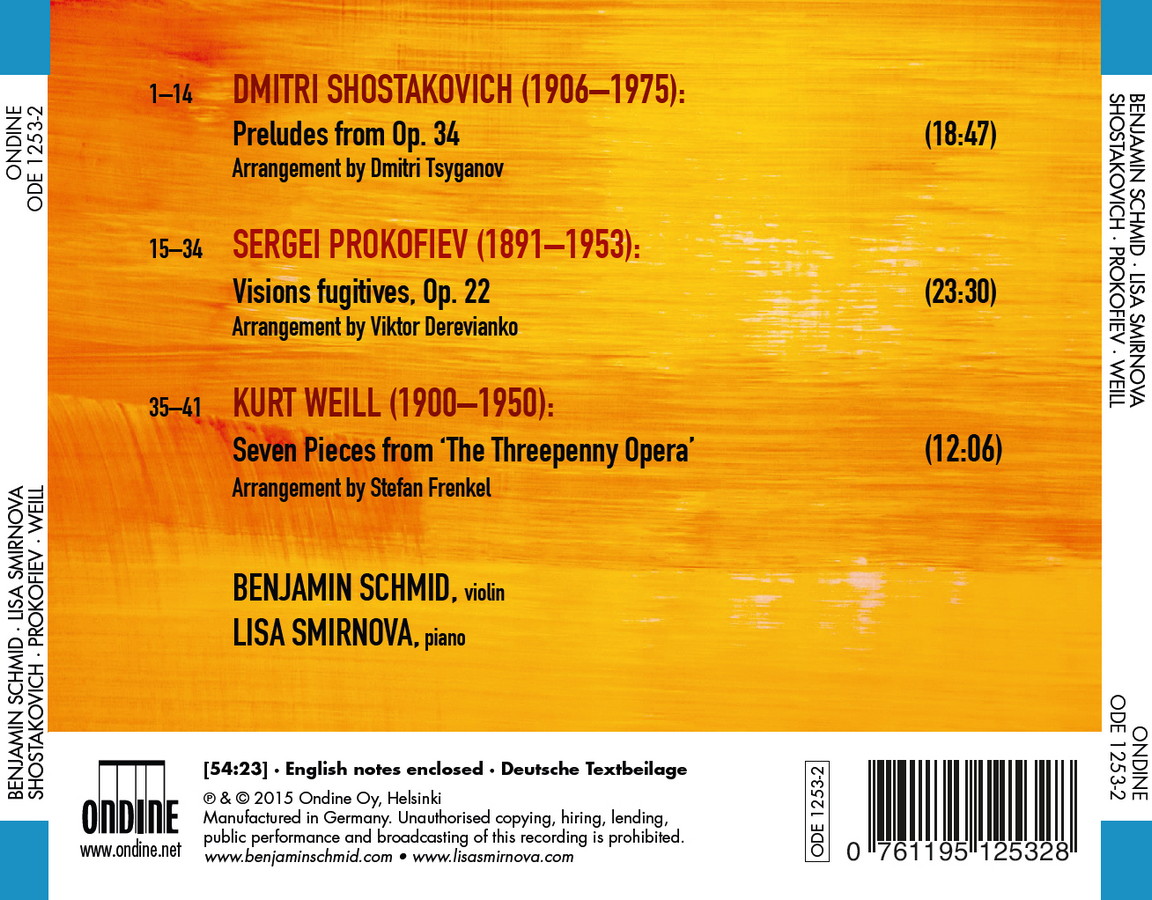
SHOSTAKOVICH, PROKOFIEV & WEILL Music for Violin and Piano

This release contains fresh arrangements of well-known piano pieces by Shostakovich and Prokofiev for violin and piano. Also included is a suite transcribed from Kurt Weill's iconic ‘The Threepenny Opera'. All the three original works by the composers were written during the 1910s and 1920s.

“I imagine not every listener will respond positively to this thoroughly unorthodox recital, in which nothing is quite as its composer intended. What cannot be denied is the passionate engagement of the soloist, a big-toned player…[and] an accomplished jazz musician…this long-gestated project has a dangerous exuberance all its own.” Gramophone Magazine, May 2015


Third release on Ondine by the Austrian star violinist Benjamin Schmid contains fresh arrangements of well-known piano pieces by Shostakovich and Prokofiev for violin and piano. Also included is a suite transcribed from Kurt Weill's iconic ‘The Threepenny Opera'. All the three original works by the composers were written during the 1910s and 1920s.

Known for his exceptionally wide repertoire and a great sense of musicality Benjamin Schmid is one of the most versatile violinists of today. Described as "one of the most valuable of today's golden-age-violinists" (The New York Sun), Schmid has performed with orchestras such as Wiener Philharmoniker, Philharmonia Orchestra, Royal Concertgebouw, Gewandhausorchester Leipzig, Tonhalle-Orchester Zürich, National Symphony Orchestra Washington, Gulbenkian Orchestra, and Chamber Orchestra of Europe. He is also a sought-after jazz violinist. In 2006 the Strad Magazine wrote: "Schmid mesmerises from his very first entry, shaping phrases with a skin-rippling sensitivity to send the spirits soaring. His golden tone, immaculate intonation, faultless technique and total identification with this magical score are truly things of wonder."

Benjamin Schmid is joined in this recording by pianist Lisa Smirnova with whom Schmid has been collaborating in an extensive way for almost 20 years.

Shostakovich wrote to Tsyganov regarding his transcriptions of the piano Preludes Op. 34: "When listening to this transcription I forgot that I wrote these preludes for the piano as they now suit the violin so well."


Wednesday, October 28, 2015

PROKOFIEV Violin Concerto No. 2, Violin Sonatas

“Viktoria Mullova's admirers will welcome this chance to hear her latest thoughts on a favourite concerto…don't expect the sweet unflappability of Guro Kleven Hagen in the main work; Mullova's interpretation is made of sterner stuff…[her] sound is as big and well-rounded as ever, not without that familiar touch of steel…competition is fierce, but then Mullova is in a league of her own.” --Gramophone Magazine, October 2015

“Mullova’s playing…is, at all times, utterly faithful to the score and is totally committed to the great Russian composer … the performances of both Sonatas could surely not be improved upon by any artist, and Mullova’s commitment here raises the stature of these works considerable.” --Musical Opinion, October-December 2015


Viktoria Mullova (violin)

Viktoria Mullova’s new ONYX album is an all Prokofiev affair recorded live, with the lyrical 2nd violin concerto joined with the solo violin sonata and the sonata for two violins. Robert Soetens premiered the Duo Sonata in Paris in December 1932, partnered by Samuel Dushkin, for whom Stravinsky had recently composed a Violin Concerto. Knowing of Prokofiev’s rivalry with Stravinsky, Soetens persuaded Prokofiev to write him a concerto. Composed in 1935 just before Prokofiev resettled in Soviet Russia, the Second Violin Concerto includes in its central movement one of his most celebrated long-arching melodies. The Solo Sonata was an official commission towards the end of Prokofiev’s life.

Originally intended for an ensemble of talented child violinists, Prokofiev so wrote the work that it could equally be played by a soloist. Paavo Jarvi and Viktoria Mullova have been close musical collaborators for many years.

“an immensely enjoyable release.” --MusicWeb International, September 2015

Tuesday, October 27, 2015

DEBUSSY, PROKOFIEV & BARTÓK Études

Garrick Ohlsson has an unbeaten reputation as the master of the miniature. In this new recital he presents three sets of Études: the twelve by Claude Debussy (so ferocious in their demands they were shunned even by elite pianists for decades), as well as Prokofiev’s revolutionary opus 2 and three works by Bartók. In all Ohlsson excels.

“His powerful technique motors through Prokofiev’s four miniatures with tremendous confidence, relishing their naughty-boy dissonances, and he treats the Lisztian flourishes that occasionally surface in the modernist currents of Bartók’s three pieces with suitable flamboyance. There are some fine moments in the Debussy set, too.” --The Guardian, 23rd July 2015 ****
 

 "The wonder of this very varied programme is that in Garrick Ohlsson’s hands these 19 Etudes shed their functional aspect (or seem to) and instead emerge as beautifully crafted miniatures. Even the opening Debussy study 'for five fingers, after Monsieur Czerny' parades colour and a sense of play before all else, whereas the Fourth Etude ('Sixths') settles on the sort of focused atmosphere more associated with his Images or Préludes. By prioritizing mood and texture over technical display Ohlsson releases the musical value of these fascinating pieces. Prokofiev’s set of four Etudes approximate chippings from the workbench where the Sonatas were crafted, the first of them a choppy, medium-paced ostinato, the Lisztian second initially slow and dark (though it closes like the Toccata), both superbly played. And then there are Bartók’s three Etudes of 1918, masterpieces all of them, the second and third like cerebral improvisations, the first hinting at the world of boogie, though the fierce frown is unmistakably Bartók’s own. Highly recommended." --Classical Ear, July 2015

Album reviews