Showing posts with label Pakistan. Show all posts

Tuesday, February 19, 2013

Bahauddin Qutbuddin Hamnava - Ya Habibi Ya Muhammad - Qawwali - Cassette from Pakistan


Ustad Bahauddin Qawwal (1934-2006) came from a family which traces its musically extremely rich lineage back to the Qawwal Bachche formed by Amir Khusrow (1253-1325). He received formal musical training from his father, Suleman Khan, and his uncle, Sardar Khan, a legendary Khyal singer of Delhi Gharana. The Delhi Gharana of Tanras Khan is a branch of the Qawwal Bachche Gharana and in both there were many famous singers of classical Raga music and of Qawwali. For example the cousin of Bahauddin, Munshi Raziuddin, a very famous Qawwali singer, was the teacher of his nephew Naseeruddin Saami, an oustanding Khyal singer from Karachi and a cousin of Bahaudin, who used to live just opposite him in the same street.
In the 1950s and 1960s Bahauddin was, together with the legendary Munshi Raziuddin, part of the ensemble of Manzoor Ahmed Khan Niazi Qawwal of whom we had posted earlier an LP (see here). In 1965 Bahaudin formed with his brother Qutbuddin his own ensemble, as did also later Munshi Raziuddin Qawwal. These three ensembles were the great representatives of the old tradition of Qawwali. Today Munshi Raziuddin's son Farid Ayaz is the best one of those carrying on this tradtion.
The German musicologist, producer and festival organizer Peter Pannke brought Bahaudin Qutbuddin Qawwal several times to Germany and Europe. He also produced a CD by him and several beautiful compilations of Pakistani Sufi music like the double CD "Troubadoure Allahs", on which there are tracks by Bahauddin. These can be obtained from: info@raga-maqam-dastgah.com.
See more about Bahauddin in the links given below. Here we present a beautiful cassette from Pakistan. It seems that the name of Bahauddin is not correctly written on the cassette (Bahaddin) but its definitely him.

Side 1 (29:06)
Side 2 (29:18) 


Many thanks again to Danny for sharing this cassette.


for Bahauddin Qawwal see:
http://www.qawalbachchay.com/?page_id=34
http://en.wikipedia.org/wiki/Qawwal_Bahauddin_Khan
see also the excellent blog: http://qaul.blogspot.com/2008/05/1969-mehfil-qawwals-raziuddin-niazi.html

For good articles on Qawwali:
http://www.qawalbachchay.com/?page_id=16
http://www.qawwalniazi.com/#!?page_id=23

Sunday, February 17, 2013

Moulvi Ahmed Hassan Beranwale Qawwal & Party - Volume 2 - Cassette published in 1980 in UK


Wonderful Qawwali cassette I bought in the 1980s in Southall. The person on the picture is the senior member of the group and father of the singer Moulvi Ahmed Hassan Beranwale Qawwal. See article below.

Side A:
1. Ya Shah-e-Jillani Pa De Khair (10:34)
2. Dekha Ke Jhalak Tum Chup Hi Gaye (19:26)

Side B:
 1. Music (5:06)
2. Yeh Sach Hai Deegar Nabion Se (24:37)


"Qawwali has been blessed with many unique voices. Some of them, like Nusrat's, Munshi Raziuddin's or Ghulam Fareed Sabri's,  are justifiably well known. Others, like Murli Qawwal's, Mubarak Ali-Niaz Ali Qawwal's or Rasheed Ahmed Fareedi Qawwal's , are probably not as widely acclaimed as they ought to be. One of the most unique voices in Qawwali was that of Maulvi Ahmed Hassan Akhter Bheranwale Qawwal. Emotive, raspy, mellifluous, with the ability to elicit tons of feeling out of a few notes. He performed mainly in the '70s and 80's with his father - who I'm 90% sure was named Maulvi Akhtar Hassan Qawwal, feel free to correct me if I'm wrong - and his younger brother Maulvi Haider Hassan Qawwal, who currently performs with the remaining members of his elder brother's Qawwali party..
Maulvi Ahmed Hassan quit performing in the late 1980s, which is a real shame because he had a voice and a performance style that was second to none. Performing traditional sufi Kalam in Urdu and Farsi with the same verve and vigour as his Punjabi performances, Maulvi Ahmed Hassan was a true representative of the Punjabi school of Qawwali; imparting a distinctly earthy feel to whatever he sang. The studio recordings he made for OSA are brilliant, with my only gripe being the fact that the recordists didn't place a microphone in front of Maulvi Akhter Hassan, with the result that we can barely hear the senior Qawwal's voice in most of them." 

Thursday, February 14, 2013

Agha Bashir Ahmad Qawwal - Vol. 1 - Qawwali - Cassette from Pakistan


Beautiful old style Qawwali. His full name: Agha Bashir Ahmad Faridi Qawwal.

Side A (30:27)
Side B (30:01)


Many thanks again to Danny who brought all these jewels from a trip to Pakistan many years ago.

Here some background information about the traditions he belonged to:
"Ustad Muhammad Ali Faridi Qawwal:
Ustad Muhammad Ali Faridi is a seminal figure in the history of 20th Century Qawwali, influencing everything from how it is performed to the position of the performers in a Qawwal party. Incorporating Classical Sufi texts with the tradtional Doaba ang of Punjabi gayeki, he created a potent style of Qawwali that proved popular both with the discerning listeners and the masses. Although his recordings date from the mid '30s to the late '60s, he started performing much earlier. Accompanied on his latter recordings by his son Abdul Rahim Faridi, the Ustad displayed a unique and very malleable voice that was very expressive in the upper registers and displayed glimpses of his rather formidable classical training. His list of shagirds includes giants like Agha Rasheed Ahmed Faridi and Agha Bashir Ahmed Faridi along with his son Abdul Rahim Faridi, who in turn instructed modern practitioners like Faiz Ali Faiz Qawwal. The Ustad's lineage continues through his grandson Moeen Ali Faridi Qawwal.

Baba Din Muhammad Jalandhri Qawwal:
When I wrote the earlier post on the Qawwals of the earlier half of the 20th century, I added Din Muhammad Jalandhri almost as an afterthought, because I didn't have any information about him that I could append to his rather wonderful recording. Over time however, I have come to learn a great deal about him and have come to realize his stature among the great Qawwals of the early 20th century. Apart from having an amazingly robust and vociferous andaz, Din Muhammad Qawwal, or Baba Deena Qawwal as the gentlemen over at Rehmat Gramophone House call him, is the forbear of not one but TWO illustrious Qawwali lineages. He was the uncle and ustad of arguably the greatest Qawwals of the 20th century, Fateh Ali - Mubarak Ali Qawwals (who are rightly called Ustadon ke ustad, which makes Din Muhammad Ustadon ke ustadon ka ustad). In turn, Fateh Ali-Mubarak Ali taught performers like the above mentioned Agha Rasheed Ahmad Faridi and Agha Bashir Faridi as well as Bakhshi Salamat Qawwal and of course, their successor Ustad Nusrat Fateh Ali Khan. And in Rahat Fateh Ali Khan, we see the fourth generation of Baba Din Muhammad carrying the torch forward. His direct lineage too, is impressive to say the least. He was the father of the amazing Miandad Khan Qawwal. Miandad Khan Qawwal and his brother Hafiz Dad Qawwal were affiliated with the shrine of Hz Baba Farid (RA) at Pakpattan and performed till Miandad's death, after which the mantle was taken over by his son, the supremely gifted Badar Miandad Khan Qawwal, who unfortunately like his father, died at a very young age. His younger brothers Sher Miandad Qawwal et al currently perform all over the world."

Tuesday, January 29, 2013

Ustad Fateh Ali Khan - Vol. 1 - Lok Virsa GM-7 - Cassette from Pakistan


Recently Bosmart had posted on his blog a couple of beautiful cassettes from Pakistan by some of the masters of the Patiala Gharana under the title "Maitres de Patiala". Here a small contibution: a cassette by the great Ustad Fateh Ali Khan, a grandson of one of the two founders of the Patiala Gharana. See about him: 
http://en.wikipedia.org/wiki/Bade_Fateh_Ali_Khan 

Ustad Fateh Ali Khan (born 1935) - Vocal
Amjad Amanat Ali Khan (1953-2002) - Vocal Support
Nazim Ali Khan (died 1999) - Sarangi
Mian Shaukat Hussain Khan (1930-1996) - Tabla

Side A:
1. Raag Megh (Vilambit) (Interview & Demonstration) (4:13)
2. Baat Geet (12:13)
3. Raag Shub Kalyan (Khyal & Tarana) (13:19)

Side B:
Raag Darbari (Khayal & Tarana) (29:48)

Tuesday, January 15, 2013

Rubab Mangi - Naghma Sazun - Pashto Rubab Music - Cassette from Pakistan


This seems to be Pashto Rubab music from the region of Peshawar in Pakistan, not far from the border to Afghanistan.

Side 1 (30:47)
Side 2 (30:32)


Many thanks to Danny again for sharing this cassette.

Sunday, December 30, 2012

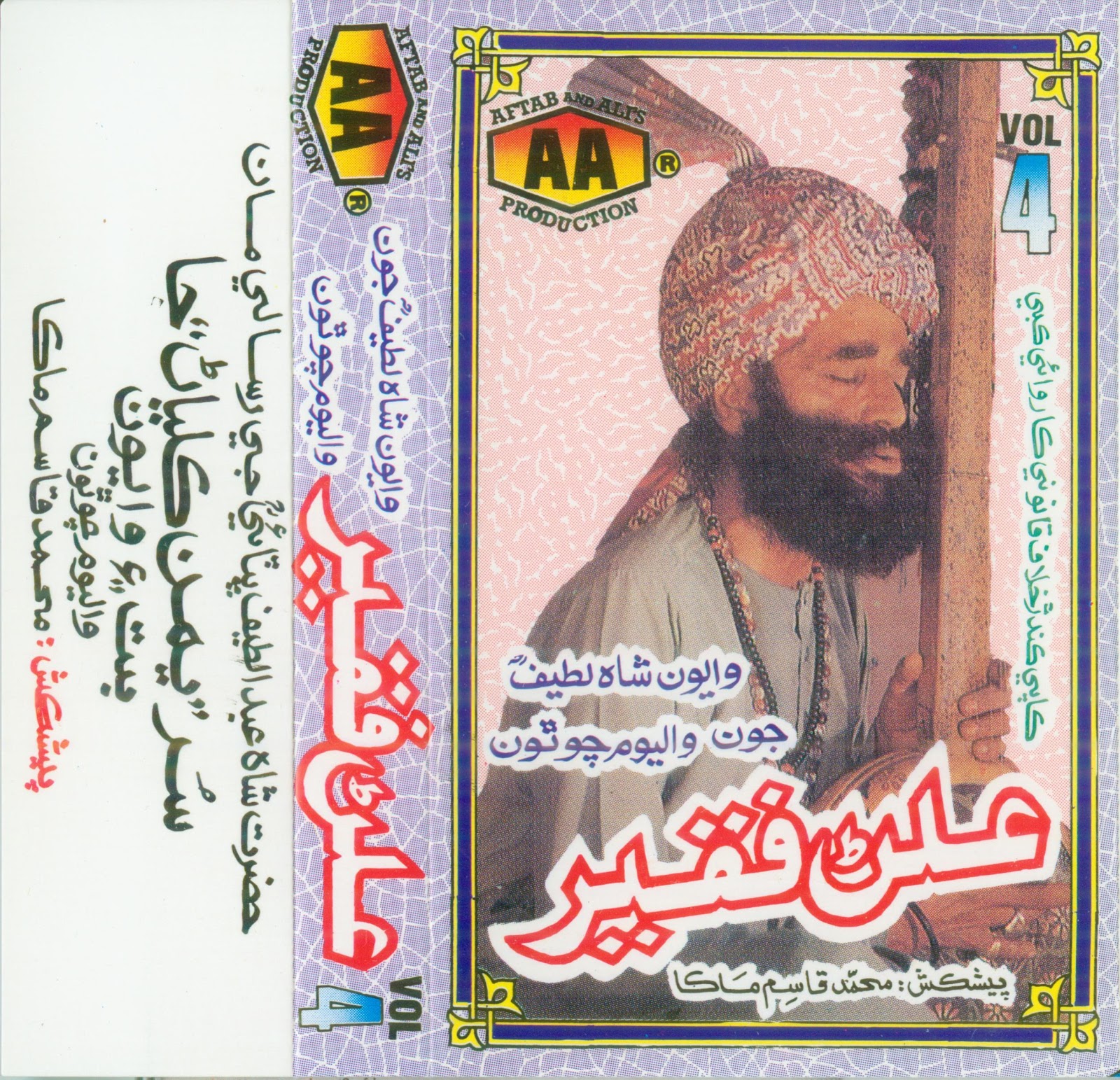
'Alan Faqir - Vol. 4 - Sufi Music from Sindh - Cassette from Pakistan


Another beautiful casette by the legendary Sufi singer.

Side A (23:57)
Side B (24:01)


Many thanks again to Danny for sharing this cassette.

Friday, December 28, 2012

Zarsanga - Pashto Folk Music - Lok Virsa FK 0015 - Cassette from Pakistan


Beautiful folk music accompanied mainly on Rabab, Flute and Dholak.

Side A (31:10)
Side B (30:46)


Many thanks to Danny for sharing this cassette.

Zarsanga is a famous Pashtu singer widely known as The Queen of Pashtun Folklore. She was born in 1946 at Zafar Mamakhel, a small village of Lakki Marwat. She belongs to a nomadic tribe that used to settle in Afghanistan in summer and stay in Lakki during the winter. In 1965, she married Mulajan, a resident of Sarai Naurang (Bannu) who was also a nomad. Many people believe she is married to popular folk singer Khan Tehsil, but she denies the rumours:
“Actually I sang with him on many occasions and most of our joint songs got immense popularity. He is not my husband he is just like my own brother”.
Zar Sanga has four daughters and two sons. Only Shehzada, her second son, has stepped into the world of music. At the start of her career, Zar Sanga would listen to the songs of Gulnar Begum, Kishwar Sultan, Bacha Zarin Jan, Khial Mohammad, Ahmad Khan and Sabz Ali Ustad. “I liked all of them, but I have maintained my own traditional way of folk singing. The people would earnestly enjoy my songs on both sides of the Durand Line (Pakistan-Afghan border). “I got no education so I cannot sing from a written paper. Most often I sing the songs that are composed and created by the common folk. However my husband also wrote some of my popular songs”, she said. A French researcher, Miss Kia, who worked with Radio France, once said Zar Sanga’s voice was the only mountainous voice in the Pashto language. Miss Kia took Zar Sanga to France for a musical concert. In France, many people were fascinated by her sweet melodies. The Pashto singer described a concert in London: “I was singing a traditional folk song in Pashto about the mountains and gypsy life of the tribals and when I finished it, a British person came close to me and proudly remarked that he was also a gypsy.” The famous numbers of Zar Sanga, which she never misses at any musical event she plays are Da Bangriwal Pa Choli Ma Za (her first-ever song on radio), Zma Da Khro Jamo Yara, Rasha Mama Zwi De, Zma Da Ghrono Pana Yara, and Kht Me Zanzeri De. Zar Sanga has been to Germany, Belgium, Iraq, Dubai, America, France and UK and has enthralled thousands of Pakhtuns and local people with her voice.

Wednesday, December 26, 2012

'Alan Faqir - Vol. 1 - Sufi Music from Sindh - Cassette from Pakistan


Side A (23:05)
Side B (23:22)


Many thanks to Danny for sharing this cassette.

'Alan (Allan) Faqir (1932-2000) was one of the foremost exponents of Sufi music in Pakistan. He was particularly known for his ecstatic style of performance marked with extreme devotional rhetoric and sufi dance singing. Deprived of a mother's love, he went off in search of someone who could replace that love. He arrived at the tomb of Shah Abdul Latif Bhitai in Bhit Shah and started living there. Faqir's memory was sharp even though he could not read and write. Hearing the traditional Latifi Raag sung every night touched his heart. Encouraged by Faqir Zawar Qurban Ali Lanjwani and Moolchand Maharaj, he began singing Bhitai's poetry at the shrine and ultimately spent twenty years there until meeting Mumtaz Mirza, who introduced him to Radio Pakistan and ptv in Hyderabad and helped him to learn the correct pronunciation of Bhitai's poetry. Eventually, he became a performing legend. 

Friday, July 6, 2012

Roshan Ara Begum (1917-1982) - A Tribute to Ustad Abdul Karim Khan - CLP 1514 - LP published in early or mid 1960s in Pakistan and India


Roshan Ara Begum, the other great lady of Kirana Gharana, was the daughter of Abdul Haqq Khan, brother of Abdul Karim Khan. She studied with her uncle Abdul Karim Khan.
Further readings:
http://en.wikipedia.org/wiki/Roshan_Ara_Begum
http://www.sadarang.com/Roshan%20Ara%20Begum.htm
http://www.archive-icm.org/roshanarabegum.htm
http://www.thefridaytimes.com/01042011/page28.shtml

Here we present her first LP. Originally published in Pakistan, the LP itself in my possession is made in Pakistan, but the cover seams to be from the Indian edition.

Side 1:
Raga Basant (26:57)


Side 2:
Raga Kidara (24:50)


Download

Monday, June 11, 2012

Mohammed Sharif Khan Poonch Wala on Vichitra Veena and Raza Been (Rudra Veena) - EMCP-5041 (1976) - LP from Pakistan


The legendary Sitar player Mohammad Sharif Khan Poonchhwala (1923-1980) was also a great Vichitra Veena player and a Raza Been (Rudra Veena) player. Here a wonderful LP by the Ustad playing these two instruments. Sitar he learned from his father Ustad Rahim Bakhsh Khan, who himself was a student of Ustad Imdad Khan. The Vichitra Veena he learned from Ustad Abdul Aziz Khan Beenkar.

Tabla: Shaukat Hussain Khan

Side 1:
1. Raag Mian Ki Todi on Vichitra Veena (12:39)
2. Raag Dais (Desh) on Raza Been (12:28)


Side 2:
1. Raag Jay Jay Wanti on Vichitra Veena (11:32)
2. Raag Bairveen on Vichitra Veena (12:41)


Musical lineage
Ustad Sharif Khan died on May 26 in 1980 and his 32nd barsi went unnoticed among the music circles of the country
By Sarwat Ali
Traditionally barsis are held to honour the memory of the ustad and provide an opportunity for other musicians to express their homage. And what better way can there be of paying a tribute than in the language of music. Barsis over the centuries have become the biggest platform for performance and recognition of the significance of music lineage.
These barsis ideally should be organised by the shagirds and the connoisseurs of music and then made into a regular affair through some systematic arrangement but it has been seen that the onus of celebrating/observing these barsis falls on the progeny of the ustad. If the progeny is enterprising and has done well in life the level of the barsi programme is reasonably high and the occasion holds some promise. But if it has not fared well then the barsi is either never held or if held fizzles out to such a sorry end that one wished that it had never been held in the first place.
Not only in the case of musicians but the other celebrated individuals, writers, poets or public figures, the barsis are usually held by the progeny or extended family of the individual. The progeny is in a certain fix in this arrangement, for if the family is involved it exposes itself to all kinds of accusations and possible slander like capitalising on the fame of an ancestor for enhancing its own status and glorifying the lineage. But if they do not venture forward then no one else does and the society is deprived of the positive fallout of the event.
The immediate family of Sharif Khan lives in Lahore but the only child who made a name for himself in sitar playing Ashraf Sharif Khan moved to Germany where he has lived now for more than 15 years. He occasionally visits Pakistan to meet his family and to possibly play at a couple of concerts in the various cities of the country. When he lived in Pakistan he was able to motivate a few connoisseurs of music and admirers of Ustad Sharif Khan to organise some event to remember and honour his father’s contribution to the sitar and vichitra veena but since he moved out of the country the annual event is now more conspicuous by it not being held.
Ustad Sharif Khan was born in Hissar which is now in Haryana, probably in the third decade of the 20th century and after dabbling with the tabla and harmonium became a musician at the court of the Maharaja of Poonch. He followed the path treaded by his father Ustad Rahim Bakhsh Khan who too was associated with the state of Poonch, and according to some was the ustad of the maharaja himself.
A virtuoso himself, Ustad Rahim Khan was from a family of vocalists but had switched to the string instruments and became an outstanding instrumentalist under the tutelage of Ustad Imdad Khan, the grandfather of Ustad Vilayat Khan. Ustad Sharif Khan himself became the shagird of Ustad Inayat Khan, the son of Imdad Khan and hence the father of Ustad Vilayat Khan.
For Ustad Sharif Khan, the going was much tougher in Pakistan. He had established himself as a sitar player before partition but the lukewarm response and lack of appreciation of classical music made him look for other avenues to meet both ends. The film was the only platform that could pay him enough to survive and thus continue with his passion of exploring the musical range of both the sitar and veena. He was initially associated with Pandit Amarnath and after partition he found creative affinity with Khurshid Anwar and for whom he played the sitar and veena in his numerous compositions.
Ustad Sharif Khan spent long hours mastering the very difficult art of playing the veena. Nobody in his family was a veena player but when he was taunted by the nephew of Ustad Abdul Aziz Beenkar that it was almost impossible to play the vichitra veena he took it up as a challenge. The balance of both the hands and the technique to be applied had immense differences in the art of playing the two instruments but he switched from the one to the other with seeming ease. The graces in particular the meends so characteristics of the veena found their way when he took to playing the sitar seriously. These meends on the sitar expanded the musical possibilities inherent in the instruments. It can be said without fear of contradiction that no other sitar player has been able to achieve it.
Though he was given the Pride of Performance and Sitara-e-Imtiaz it was difficult for him to keep two ends meet. He really had to struggle hard and it was at the cost of his health. In most of the recordings he could not hold back his coughing and it also got recorded with his priceless music. Struggling to keep economically solvent in a society with only a qualified acceptance of music cost him dearly and he died in 1980 at the prime of his creative life.

Friday, June 8, 2012

Habib Ali Khan Beenkar (1898-1971) - Vichitra Veena - Raag Aimen and Raag Maroo Baihaag - ALPC. 13 - LP from Pakistan


Wonderful LP by Ustad Faqir Habib Ali Khan Beenkar, published in Pakistan probably beginning of 1970s.

Side 1:
Raga Aimen (Yaman) (27:15)


Side 2:
Raga Maroo Baihaag (Maru Bihag) ( 27:30)


A fantasic short video of Ustad Habib Ali Khan 
and Ustad Ahmedjan Thirakwa 1937:
Late Ustad Abdul Aziz Khan Beenkar (Patiala Gharana) (older brother of Habib Ali Khan)

The Vichitra Veena emerged towards the beginning of the twentieth century and is descended from the ektantri veena or the ghoshvati veena as it was known, prior to the 6th century. It shared the same sound production techniques as the ektantri. The credit of giving the vichitra veena its present shape and developing its modern style of playing goes to Abdul Aziz Khan, a former sarangi player of Patiala. Today, the vichitra veena remains a rare instrument, with not many artists who play this instrument.
In the beginning Abdul Aziz Khan used to play on the tanpura, putting an extra gourd on the upper side and placing the instrument in front of him. Slowly, with the help of many instrument makers, he gave shape to the instrument. In general appearance and structure, the rudra and vichitra veena look similar – the main difference being the production of sound.
The rudra veena has frets whereas the vichitra veena is a fretless zither. While playing, the rudra veena is held diagonally across the body of the player in such a manner that the upper gourd rests on the shoulder and the lower one rests on the thigh, whereas the vichitra veena is put in front of the player while playing. To produce notes, a paperweight or a rounded glass piece is held and slid upon the strings using the left hand.
Playing fretless instruments, especially with a slide, has to be precise by micrometers in order to get the right note. A minute deviation from the exact place will render it out of tune. Thus, it is rather difficult to play the fast passages on the vichitra veena, but pieces played at a poised and slow pace could be very rich and full of tonal beauty.
The vichitra veena is a rare instrument. There are not many artists who play this instrument. Besides, manufacturing the instrument is very laborious and also very expensive. Thus, there are not many instrument makers who can take up this tedious job.
Among the students of Abdul Aziz were Ahmed Raza Khan, Mohammad Sharif Khan Poonchwale and his own brother, Habib Ali Khan. In the sixties and seventies, Prof. Lalmani Misra attained fame in vichitra veena playing. Although influenced by Abdul Aziz’ technique, he developed his own style. Some of the other artists who are associated with this rare instrument are Lalmani’s son, Gopal Shankar Misra, Gopal Krishna Sharma, and Ramesh Prem.
 - Text includes inputs from "Classical Instruments of India" by Dr Suneera Kasliwal

Tuesday, June 5, 2012

Ustad Sabri Khan - Sarangi - Cassette published 1989 in Pakistan


Side 1:
1. Raga Puriya Kalyan (13:19)
2. Raga Gorh Sarang (7:54)
3. Raga Misra Peelu (8:07)

Side 2:
1. Raga Pancham (7:26)
2. Raga Sham Kalyan (5:15)
3. Tabla solo: Teen Tal (5:29)
4. Raga Sri (3:55)
5. Raga Misra Khamaj (7:18)

Monday, May 7, 2012

Mohammed Shareef Khan Poonchwala - Sitar - A Tribute to Hazrat Amir Khusrau - LP EMCPM-5013 (1975)


Ustad Mohammed Shareef Khan Poonchwala - Sitar
Mohammed Tufail Narowali - Tabla

On the first edition of this LP the music on one side was distorted. Later the LP was republished as LKDE-20020. The new edition did not have this distortion, but unfortunately it came with a generic cover. So we present here the music of the second edition, but the cover of the first edition. This is the 4th LP by the great master on this blog. We still have a 5th LP, which we will post in the future.

Side 1:
Raag Saz Giri (20:39)


Side 2:
Raag Surparda (21:03)


Sunday, April 15, 2012

Ustad Bundu Khan (1880-1955) - More recordings


More than 10 years ago I received - I don't remember anymore from whom - on a CD some unidentified tracks by the Sarangi master. Probably these are also radio recordings. The Sarangi player, teacher and connoisseur Dr. Kashyap identified them recently for me. Here they are:

1. Jaunpuri (9:50)
2. Sorath (9:34)
3. Malkauns (0:58)
4. Bageshree (2:47)
5. Adana (13:50)
6. Bhairav pt. 1 (8:51)
7. Bhairav pt. 2 (10:05)
8. Shahana Bahar (11:35)

Regarding the last track, Dr. Kashyap said: "interestingly different from what we have in his radio program, played at another occasion with a different sarangi."

Thursday, April 12, 2012

Ustad Ummeed Ali Khan (1910-1979) - Tirvan, Bairagi, Darbari, Malkauns - A Radio Pakistan Production - LP LKDR-12 (1973)


A legendary singer of the Gwalior Gharana in Pakistan
Recordings from the archives of Radio Pakistan

Side 1: 
1. Raag Darbari (14:36)
Sarangi: Zahid Hussain
Tabla: Allah Ditta Khan
2. Raag Tirvan (11:00)
Sarangi: Nathu Khan
Tabla: Ashiq Hussain


Side 2:
1. Raag Malkauns (13:21)
Sarangi: Nathu Khan
Tabla: Ashiq Hussain
2. Raag Bairagi Bhairon (12:14)
Sarangi: Abdul Hameed
Tabla: Talib Hussain  


"Naushad Firdausi, wrote this in the Usenet newsgroup rec.music.indian.classical (RMIC):
Ustad Ummeed Ali Khan was a true blue Gwalior. His father Ustad Meeran Baksh was the son of Ustad Boorey Khan, who was nephew of Ustad Banney Khan whose sons Ustads Jamal Khan, Misri Khan and Saindhey Khan were all renowned gharanedar Gwalior khayaliyas. Ustad Haddu Khan was the grand Uncle of Ustad Banney Khan who incorporated many traditional punjabi folk compositions into khayal bandishes. Ustad Ummeed Ali’s only connection with Patiala Gharana was that he sometimes used to perform in jugalbandi with Ustad Ashiq Ali Khan. Many anecdotes of their friendly rivalry but I’ll leave them for later.
In his later years Ustad Ummeed Ali had lost his eyesight (it seams that this is incorrect, he rather lost his hearing) completely. Yours truly saw him travelling in a tonga many times along with Ustad Natthu Khan sarangiya to the Lahore radio station. That’s where I heard him singing all those wonderful raags like Tirvan, Champak and Neelambari (mitwa baalamwa — still rings in my ears ! ) etc. One only can hope that those recordings exist in radio archives somewhere !! For recordings try your luck with some firanghs who manage to slither into the radio archives one way or another !!"

Thursday, April 5, 2012

Sarangi legend Ustad Bundu Khan (1880-1955) - A radio broadcast from All India Radio, Delhi


Ustad Bundu Khan, probably the most outstanding sarangi player during the first half of the 20th century, was born in Delhi, in a family of musicians. He received his early training in sarangi from his father Ali Jan Khan and later from his uncle Mamman Khan, who was attached to the Maharaja of Patiala.
Bundu Khan was a prodigiously talented artiste and also a very sincere and hard-working student of music. His complete mastery over his delicate and difficult instrument not only placed him on the top rung of the subcontinents sarangi players but also made him one of the most proficient Hindustani instrumentalists of the 20th century. He had a flair for singing and writing poetry as well. His sons, Umrao Bundu Khan and Buland Iqbal, also inherited his talents.
He played the sarangi from the Delhi Radio Station, when its broadcast was started in 1935. He became court-musician to Maharaja Tukaji Rao Holkar of Indore and was also in the Rampur court of a brief period. He was highly influenced by Pandit Bhatkhande whom he met in Indore. He devoted himself to the study of musicology, and wrote a book Sangeet Vivek Darpan wherein the ragas Bhairabi and Malkauns were elaborately discussed.
After migrating to Pakistan after the partition in 1947, Ustad Bundu Khan continued to play the sarangi from all the radio stations of Pakistan till his death in 1955. Both his sons gained prominence and became immediately known to the music circles of Pakistan. In addition to his descendants, he trained Amir Muhammad Albi, Durkhu Singh, Majid Khan, Muhammad Sagiruddin Khan and P. N. Nigam. He was posthumously awarded the Pride of Performance by the Government of Pakistan in 1985.
from: http://www.itcsra.org/tribute.asp?id=14 There you find some beautiful tracks.
See also: 


A National Program on Bundu Khan, in English, presented by his student Rajesh Bahadur, broadcast by All India Radio, Delhi. It contains these performances:

Part 1 (45:27):
01 Chandni Kedar 12:31 (starting at 8:43)
02 fragment 0:35 (starting at 22:38)
03 Gaud Malhar 15:03 (starting at 24:37)
04 fragment 2:33 (starting at 40:40)
05 Dhrupad Sagar (Ragamalika) 1:59 (starting at 43:27 and continuing in part 2)

Part 2 (44:41):
01 continuation of Dhrupad Sagar (Ragamalika) 2:29
02 Chandrakauns 6:21 (starting at 3:14)
03 Shahana Bahar & Bageshree Bahar 26:22 (starting at 11:59)
04 Bhairavi 4:17 (starting at 38:51)
Download Part 2

Further - very enjoyable - readings: look here under "About Bundu Khan"

Tuesday, August 30, 2011

Munir Sarhadi (1922-1980) - Sarinda - Music from Peshawar - Cassette from Pakistan


Recorded and published by National Institute of Folk and Traditional Heritage, Islamabad, Pakistan. Originally published on LP as "Sarinda - Sound of Khyber Valley" by EMI Pakistan (LKDE-20009). Later republished as this cassette with two additional tracks (not mentioned in the list of tracks).

Side 1:
1. Dance Tune (5:37)
2. Sakhni (6:12)
3. Khyber Laugari (6:16)
4. Dance Tune (6:06)
5. extra track (5:01)

Side 2:
1. Khattak Dance on Sarinda (6:25)
2. Sandra (5:19)
3. Qizilbashi (5:35)
4. Nimkaee (5:03)
5. Loba (4:09)
6. extra track (4:04)


Munir Sarhadi—the sarinda virtuoso
By Shaikh Aziz
A music concert is on, continuing till the wee hours of the morning. Many vocalists and instrumentalists are showing their skills. Every performer thinks that his was the best performance on the stage. One girl in the audience is overwhelmed by the performance of an instrumentalist and becomes such an admirer that she falls in love with him. Cupid’s arrow has done it’s work and one fine day they tie the nuptial knot.
Incidentally, this happened in Delhi, a little before Independence. The artist was Munir Sarhadi, the sarinda virtuoso who won laurels in the country and abroad, and the girl was Banu Begum, who attended a concert in Delhi, filled with a galaxy of vocalists and instrumentalists from all over the subcontinent. A young Munir had gone there with his illustrious father, Ustad Pazeer Khan, who was employed by the All India Radio at that time.
Munir Sarhadi, the Peshawar-born musician, later rose to fame not only in Pakistan but also won laurels abroad. A winner of the Pride of Performance, the legendary instrumentalist was perhaps the only artist after his father who achieved that recognition in playing the traditional instrument. Paradoxically, his death in 1980, was marked by utter poverty and neglect — an end most of our artists often meet.
Munir was born in 1922. His father was the great scion of sarinda players of Pushto music. In his childhood he showed no interest in learning the instrument which was not liked by some of his family elders. His father left for Delhi where he had gotten a job at the All India Radio. His uncle and custodian, Khushmir Khan tried to persuade him to learn the music but all in vain. One day, a dejected Munir left Peshawar and travelled to his father’s city. His father did not want to teach him and took him to Ustad Afzal Hussain, one of his colleagues at the radio. There Munir began learning vocal music.
It is then that the young boy developed interest in sarinda. When his father left for work everyday, he would pick up the sarinda and start practising it. This continued for quite some time. One day his father came a bit earlier than his scheduled time and was stunned to see that Munir was playing the instrument with great skill. Ustad Pazeer Khan was so overjoyed that he gave his own sarinda to Munir and then began teaching him the intricacies of music and sarinda playing. With the skill he saw in his son, Ustad Pazeer Khan knew what lay ahead for Munir.
Soon after, the father and son decided to visit Peshawar for a vacation. It was also a family reunion and obviously in a family of musicians there had to be music. Munir’s family was astonished to see him pick up the sarinda and play it. The masterly handling of the bow and strings produced such scintillating compositions that everybody was enthralled. To see the young lad, who was not interested in music, playing like a wizard, was no less than a miracle.
After a short stay at Peshawar, both the father and son went back to Delhi where they played the instruments and also sang thumries and ghazals at various concerts, to supplement the earning. At one concert when Munir began playing the sarinda everybody in the audience was taken over by its magic. One veiled girl was simply mesmerised. She began attending every concert of Munir and ultimately both tied the knot.
When Independence took place Delhi became a hotbed of violence, and with the help of a friend in the army the family managed to reach Pakistan safely and decided to settle in Lahore. Finding no place at Radio Pakistan, Lahore and roaming jobless for quite some time, they finally moved to Peshawar in very poor conditions.
Here the father and son were able to get jobs in Radio Pakistan. In 1949 Ustad Pazeer Khan died of respiratory disorder and it was now Munir Sarhadi who had to advance the tradition of sarinda playing. Munir, through his strenuous riyaz and able guidance of the father, had become a master of sarinda and was in great demand all over Pakistan. He attended almost all the concerts and music festivals that used to be held at various centres. The PIA Academy, which was established to promote art and culture of the country, took him to various parts of the world including China as member of the troupe where his performance was highly applauded.
Munir Sarhadi’s technique was very imaginative. He played every raga and folk composition with masterly ease. Sarinda, the fretless stringed instrument, is comparatively a difficult instrument in the string family as it has little space between the bridge and knobs, and requires extra ability to produce the three octaves. Munir, through his extra effort, easily acquired this skill and played classical taans to folk lehra as an accomplished performer. He had the ability to sing, play and also compose music. He was so engrossed in the music and sarinda that he hardly passed a day without playing it after he decided to learn it and make it a living. While his father excelled in folk tunes and classical music, Munir created a fusion of the two. This is evident from the films Dara-i-Khyber, Baghi and some other films of which he composed the music. He blended classical music with some variations from Pushto music and vice versa. For his services towards the promotion of music, he was awarded the Pride of Performance.
Personally he was a simple, hard working and dedicated person. He had no greed for money and worldly comforts. Throughout his life his main concern was music. He longed for the company of the learned. Perhaps this was the reason that in the last days of his life he lived a miserable life. As usual, our bureaucratic clique, societies and the so-called organizations meant for the promotion of art remained unmoved, while the maestro was on his deathbed. His only source of living, the radio salary was not enough to provide him the medicines and on May 23, 1980 he died in abject poverty, yet with honour and dignity, leaving behind an invaluable contribution towards music. After his death only one of his sons, Aijaz Sarhadi has kept up the family tradition of sarinda playing and is known well in the Pakistani music world.—DAWN

See about the instrument: